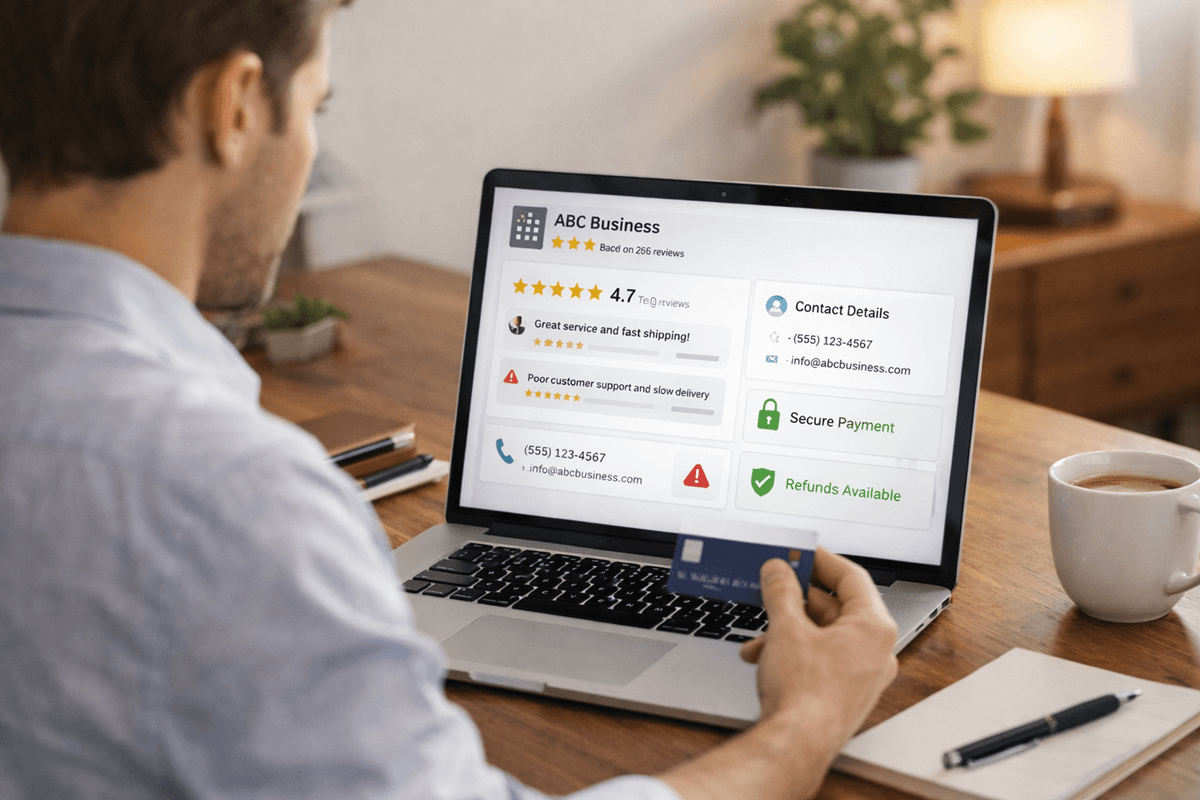

Before buying from a business, check five things first: who they are, what customers are saying, how their policies read, how they ask you to pay, and how they deal with problems.
That simple check catches a lot of bad decisions early.
A business does not need to look perfect. It needs to look real, clear, and accountable. Too many people buy because a website looks polished or a discount feels urgent. That is usually not enough.
A better approach is to slow down for a few minutes and check the basics properly.
Start with the business itself
Before you read reviews, look at the business on its own.
Ask yourself one simple question: does this look like a real business, or just a page trying to close a sale?
That question helps more than people think.
Check if the business is clearly identified
A trustworthy business should make a few things easy to find:
- business name
- what it sells
- who the product or service is for
- how to contact them
- what happens if there is a problem
If that basic information is hard to find, that is not a great sign.
A real business usually explains itself clearly. You should not have to guess what it does or who it serves.
Look at the contact details
This is one of the easiest checks, and it tells you a lot.
Look for:
- a real contact page
- an email address
- a phone number if relevant
- a business address if relevant
- clear support options
Not every online business needs all of these. But there should be some clear way to reach them.
If a business is hard to contact before you buy, it may be even harder after you pay.
Read the About page if there is one
The About page can be useful.
You are not looking for a dramatic brand story. You are looking for something that feels clear and believable.
If the copy sounds vague, copied, or full of oversized claims, pay attention to that.
Read reviews properly, not quickly
A lot of people make the same mistake here.
They look at the average rating, scan two reviews, and decide. That does not tell you much.
The better question is this: what pattern do the reviews show?
Look for details, not just praise
Useful reviews usually mention real things:
- what the person bought
- how delivery went
- whether support replied
- whether a refund was given
- how a problem was handled
That is more useful than a review that only says “Amazing service” or “Highly recommended.”
Good reviews do not need to be long. They just need to feel real.
Focus on repeated complaints
One bad review is not the problem.
Repeated complaints are.
If different people keep mentioning the same issue, that matters.
Watch for patterns like:
- no reply from support
- refund problems
- delayed orders
- products not matching the description
- aggressive responses from the business
A few unhappy customers are normal.
The same complaint showing up again and again is different.
Check how the business replies
This part matters more than people think.
Any company can look good when things go smoothly. The real test is how they act when someone is unhappy.
A good reply usually sounds:
- calm
- respectful
- clear
- willing to help
A bad reply often sounds:
- rude
- defensive
- dismissive
- more interested in arguing than solving anything
That tells you a lot about what kind of experience you may get later.
Read the policy pages before paying
This is the part many buyers skip.
Then they regret it later.
If you want to know whether a business is worth trusting, read the policy pages before you buy, not after something goes wrong.
Check the refund and return policy
You want clear answers to simple questions:
- are refunds allowed
- how many days you have
- are returns accepted
- who pays for return shipping
- are there restocking fees
- are there excluded items
A strict policy is not always a red flag.
A vague one is.
If the wording feels slippery, confusing, or hard to find, be careful.
Check delivery or service terms
If you are buying a product, read the shipping terms.
If you are paying for a service, check what happens next.
Look for:
- delivery time
- service timeline
- delay terms
- support after purchase
- cancellation terms
A decent business usually explains these things clearly.
A weak one leaves too much unclear until after payment.
Check how they ask you to pay
Payment method is a trust signal too.
A proper business usually gives you normal, secure ways to pay.
Better signs
- secure checkout
- known payment providers
- clear pricing
- clear currency
- normal order confirmation
Red flags
Be careful if a business pushes you to:
- pay by bank transfer only
- send money to a personal account
- use crypto without buyer protection
- complete payment outside the normal checkout flow
- rush into payment before you review the terms
This does not always prove the business is fake.
But it does raise the risk.
Search beyond the business website
Do not rely only on what the company says about itself.
A business website is part of the picture. Not the whole picture.
Search the business name with a few extra terms
Try searching the business name along with words like:
- reviews
- complaints
- refund
- scam
- customer service
- support
This helps you see whether the same issues appear in more than one place.
You are not looking for a spotless reputation. That rarely exists.
You are looking for consistency.
Check if the details match across the web
Basic details should line up.
That includes:
- business name
- website address
- support details
- location, if relevant
- what the business actually offers
If key details do not match, slow down.
That kind of inconsistency is easy to miss when you are in a hurry.
Know the difference between normal issues and real red flags
Not every problem means you should walk away.
Some issues are annoying but normal. Others are more serious.
Normal issues
These may not be deal-breakers on their own:
- one delayed order
- a few mixed reviews
- one bad support interaction
- complaints about price rather than service
Look at the full picture.
Real red flags
These deserve more caution:
- repeated complaints about refunds
- missing orders
- no real support contact
- unclear business identity
- pressure to pay in risky ways
- aggressive replies to criticism
- policies that feel written to avoid responsibility
If several of these show up together, that is usually enough reason to stop.
A quick trust check before you buy
If you want a simple system, use this.
- Do I know who this business is?
- Can I contact them easily?
- Do the reviews sound real?
- Are complaints minor or serious?
- Does the business reply properly?
- Is the refund policy clear?
- Does the payment method feel safe?
- Do the details look consistent outside the website?
If too many answers are no, that is your answer.
Common mistakes people make
Trusting the website design too much
A polished site helps, but it proves very little.
Some poor businesses look great online. Some solid businesses look plain.
Looking only at five-star reviews
The best reviews are not always the most positive ones.
They are the ones that give you something real to work with.
Skipping policy pages
People ignore them because they look boring.
Then they are surprised when the refund process is harder than expected.
Buying too fast
Urgency works. That is why so many businesses use it.
But if a business is worth buying from, taking ten extra minutes to check it should not ruin the deal.
FAQ
How do I know if a business is trustworthy before buying?
Check the basics first. Look at business identity, contact details, reviews, refund terms, payment methods, and complaint patterns. Then see whether the same details make sense outside the company website.
Are bad reviews always a bad sign?
No. Most real businesses get some bad reviews. The bigger issue is repeated complaints, weak responses, or clear patterns that point to the same problem.
What is the biggest red flag before buying from a business?
Repeated complaints about refunds, missing orders, no customer support, and unclear business details are some of the biggest warning signs.
Can a business still be trustworthy if it has mixed reviews?
Yes. Mixed reviews can be normal. What matters is whether the feedback feels believable and whether the business handles problems in a reasonable way.
Final word
If you want to know whether a business is worth trusting before you buy, do not look for one perfect sign.
Look for a pattern.
Check the business itself. Read the reviews properly. Read the policies. Look at the payment methods. Search beyond the website.
Most of the time, the warning signs are there. People just miss them because they move too fast.
Comments (0)